VegasHero KYC and Account Verification
 Available in GB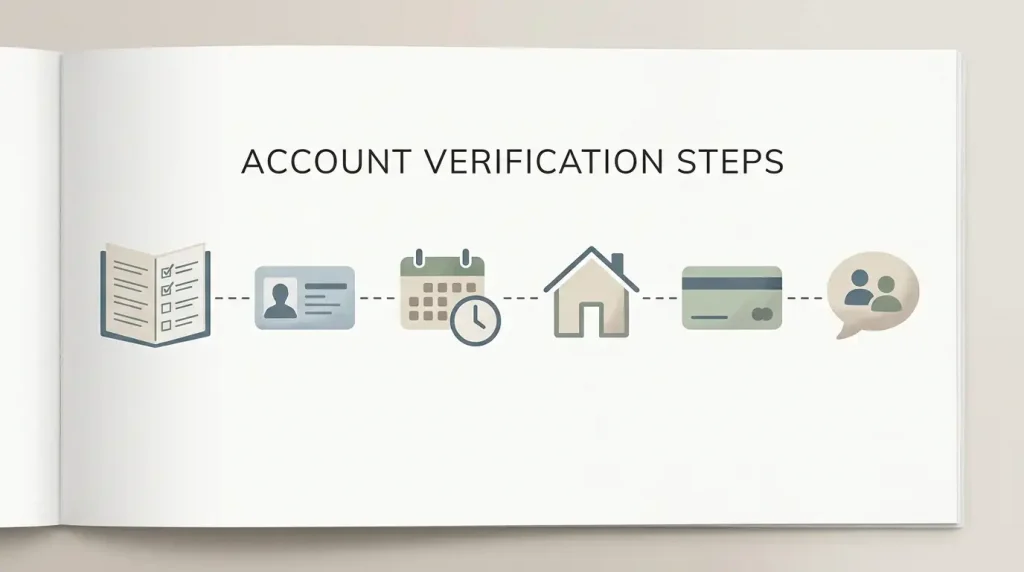
VegasHero account verification can apply before or after deposits and around withdrawals. The current General Terms v1.12, last updated 19 August 2026, state that the operator can request information to verify identity or source of funds, including certified ID, proof of residence and proof of ownership or transaction history for payment methods. The Terms give customers 30 days to provide requested documents and say verification is usually completed within 10 days after the request has been answered in full, although more time or checks can be required in a complex case.
This page separates VegasHero-specific evidence from general KYC context. It also explains Great Britain rules only as regulator context for UKGC-licensed remote operators. The project has not verified a current UKGC licence for the present VegasHero operation, so UKGC requirements are not presented as proof of how VegasHero itself currently handles verification.
Table of Contents
- What is actually verified about VegasHero KYC?
- Why a casino may ask for verification
- KYC and withdrawals
- What documents should you prepare?
- How to reduce avoidable verification delays
- Where to look for a genuine VegasHero verification request
- Great Britain financial vulnerability checks are separate from KYC
- Do not call the UKGC rule an affordability check
- Safer-gambling and support context
- A practical KYC checklist
- Source-status summary
- Bottom line on VegasHero verification
What is actually verified about VegasHero KYC?
The current Terms support a clear conclusion: account verification can be part of the VegasHero customer journey. Section 5 says the operator may request information needed to manage the account, verify identity or establish the source of deposited funds. The examples include properly certified ID, proof of residence, proof of ownership of payment methods and transaction histories such as bank or card statements. These are examples in the Terms, not a promise that every customer will be asked for every item.
Timing is also stated in the current Terms. Customers must provide requested documents and information within 30 days of the request. Once the request has been answered in full, VegasHero says it will usually verify the material within 10 days, while reserving extra time or additional checks for more complex cases. That wording is not a guaranteed ten-day maximum; it is the operator’s current published usual-processing statement.
For the initial signup sequence, see the registration guide. Registration and verification are related but separate: creating an account does not prove that all later checks are complete.
Why a casino may ask for verification
KYC generally serves several purposes in remote gambling: confirming identity and age, checking that account details belong to the customer, reducing misuse of payment methods, and supporting anti-fraud or anti-money-laundering controls. Those are general industry functions, not a claim that VegasHero uses a particular document workflow or a particular vendor.
Verification can also become relevant when information does not match across an account, a payment method and a withdrawal request. That is why accuracy at registration matters. A typo in a date of birth, an outdated address or use of a payment method that does not clearly belong to the account holder can create avoidable friction even when no wrongdoing is involved.
The safest preparation is therefore consistency rather than document guessing. Use truthful personal details, keep access to the email address linked to the account, and avoid funding the account through another person’s payment method unless the operator explicitly permits that arrangement.
KYC and withdrawals
Verification is especially important to understand before requesting a payout. A withdrawal request can trigger or expose unresolved account checks, and a customer who has not completed requested verification may need to do so before funds are released. This page does not state an exact VegasHero verification deadline or a guaranteed payout-after-KYC interval.
If a withdrawal is pending and the account displays a verification request, deal with that request through the official account area or verified support channel rather than opening a second account or repeatedly submitting the same withdrawal. Keep copies of correspondence and note the date on which requested information was submitted.
For payment-specific questions, including the current withdrawal workflow and the distinction between operator review time and external payment-network time, use the withdrawals. The KYC page should explain verification, not duplicate every cashier rule.
What documents should you prepare?
VegasHero’s current Terms provide examples rather than one universal checklist. They say verification information can include properly certified ID, proof of residence, proof of ownership and transaction histories for payment methods, including bank or credit/debit-card statements. A separate refund clause gives examples of identity documents such as a passport, driving licence or identity card and address evidence such as a utility bill, bank statement or rental agreement. The request shown for your own account determines what is actually required.
If your account asks for a document, read the exact on-screen instructions before uploading anything. Check whether the request specifies document type, date range, file format, image quality, visible edges or whether sensitive fields should remain visible. Do not assume that a document accepted by another operator will automatically be accepted here.
Never send a full password, card PIN or other credential that should not be shared. If a request looks unusual, confirm it through the official site or verified support before transmitting personal information.
How to reduce avoidable verification delays
Start with accurate account data. Your name, date of birth and address should match the information you can legitimately substantiate. If your address has recently changed, use the current value requested by the live form and follow any account-update process rather than creating inconsistent versions of your profile.
When submitting an image or file, make it readable. Blurred photographs, cropped edges, glare and digital images that omit requested details can lead to repeat requests. Again, that is practical document-handling advice, not a claim about an exact VegasHero rejection policy.
Use the same account for the whole process. Creating a duplicate account to bypass verification or a withdrawal hold can create a separate account problem. If the issue is simply that the verification screen is not loading or the request is unclear, contact support instead.
Where to look for a genuine VegasHero verification request
Begin inside the logged-in account and any help or verification area linked from it. A legitimate request may also be referenced in account-related email, but follow links carefully and verify the destination domain before uploading personal files. If there is uncertainty, navigate to VegasHero directly rather than relying on a link in an unexpected message.
Support is the next escalation point when an account request is unclear, a document upload fails or a withdrawal appears to be waiting on verification. Ask a precise question: what is still required, where should it be submitted, and whether the account status shows the item as received. Precise questions are more useful than asking whether the account is simply “verified”.
Do not send extra documents that were not requested merely to speed things up. More personal data does not necessarily make a review faster, and unnecessary disclosure creates additional privacy risk.
Great Britain financial vulnerability checks are separate from KYC
For UKGC-licensed remote operators, the Gambling Commission’s current Social Responsibility Code requires a financial vulnerability check when deposits minus withdrawals exceed £150 in a rolling 30-day period. The check uses customer-specific public-record information such as bankruptcy orders and certain debt-related judgments. It is not the same thing as a standard identity-document upload.
This regulatory rule is useful background for readers in Great Britain because it shows why “verification” can refer to different processes. Identity checks, payment checks, financial vulnerability checks and customer-interaction measures should not be collapsed into one vague concept.
However, this project has not verified a current UKGC licence for the present VegasHero operation. The UKGC threshold therefore describes obligations for UKGC-licensed remote operators generally; it does not prove that VegasHero currently applies that exact UKGC process. For the licence evidence itself, read the licence check.
Do not call the UKGC rule an affordability check
The Gambling Commission distinguishes financial vulnerability checks from the separate financial risk-assessment work it has piloted. The current vulnerability check is based on public-record indicators and the £150 rolling-30-day net-deposit threshold. Calling every such check an “affordability check” can misstate the regulator’s terminology and imply a broader income-and-spending assessment than the rule actually requires.
That distinction matters on a KYC page because users often interpret any request for information as a single compliance process. In reality, an operator can have different reasons for checking identity, payment ownership, account behaviour or public-record vulnerability indicators. Only the specific request shown to the customer tells you which process is actually in front of you.
Safer-gambling and support context
The current Terms also give a direct self-exclusion route: section 3.8 says customers can contact customer service by email at [email protected] for assistance closing the account through self-exclusion. That is a current first-party instruction, separate from KYC and separate from the UKGC-specific protections discussed elsewhere on this site.
If your reason for contacting support is not document verification but a need to stop gambling, use the current safer-gambling tools and support options visible in the live account or website. A KYC request should not distract from a more urgent decision to restrict access or seek help.
Do not infer a specific verification process from generic responsible-gambling wording. Exact document requests, timing and account checks should be taken from the current account instructions or official terms when they appear.
A practical KYC checklist
- Make sure the personal details entered at registration are accurate and current.
- Expect that verification can apply, especially around account or withdrawal review.
- Read the exact live request before deciding which document to provide.
- Do not rely on a review that publishes a fixed document list without current official sourcing.
- Submit readable files only through an official account area or verified support route.
- Keep a record of what you submitted and when.
- Do not send passwords, PINs or unrelated personal records.
- If the request is unclear, ask support what item remains outstanding and where it must be supplied.
Source-status summary
| Topic | Current status | How to use it |
|---|---|---|
| KYC can apply | Supported | Plan for the possibility of verification. |
| KYC document scope | Verified in current General Terms | Terms give examples including certified ID, proof of residence and payment-method ownership/history; the live request determines the exact items. |
| KYC response and review timing | Verified in current General Terms | Requested information is due within 30 days; verification is usually within 10 days after a complete response, with extra time possible for complex cases. |
| UKGC £150 financial-vulnerability threshold | Verified regulator rule for UKGC-licensed remote operators | Use as Great Britain regulatory context only. |
| Current VegasHero UKGC licence | Not verified in this project | Do not infer UKGC protection from the existence of an account or KYC process. |
Bottom line on VegasHero verification
Prepare for verification, but do not prepare from an invented checklist. The useful confirmed point is that account checks can arise and can matter to withdrawals. The useful limitation is equally important: the Terms provide examples and a usual review timeframe, but the exact request still depends on the individual account and case.
Keep account information consistent, respond only to the specific request shown through official channels, and escalate unclear requests through support. For the broader brand picture, return to the main VegasHero review. The registration and payout guides linked above cover their own processes, while the licence page should be used for regulatory status rather than treating KYC as evidence of local licensing.
VegasHero Bonus and Welcome Offers for UK Readers
VegasHero Licence and UK Regulatory Context
No verified current UK Gambling Commission licence was found for the present VegasHero operation in...
VegasHero Sportsbook: Sports, Live Betting and Betting Promotions
VegasHero is not limited to casino games. Its current sportsbook includes pre-match sports betting, live...
VegasHero Registration and Account Setup
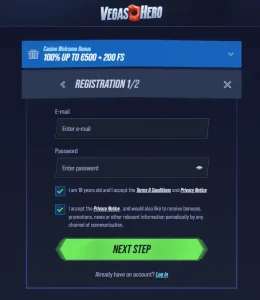
VegasHero's current registration journey starts with a decision before the usual account form: choose a...
VegasHero Bonus and Welcome Offers for UK Readers
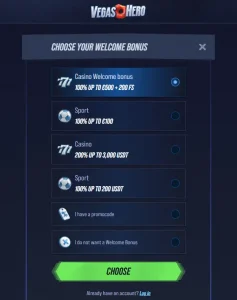
VegasHero's registration screen currently displays a casino welcome bonus of 100% up to €500 plus...

VegasHero Games: Slots, Tables, Jackpots and Providers
VegasHero currently advertises thousands of casino games rather than a fixed public total. Its live...
VegasHero Payment Methods: Deposits, Wallets and UK Payment Context
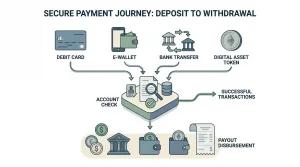
VegasHero has a dedicated payments area that separates deposits from withdrawals and asks the user...

VegasHero Mobile: Browser Experience, iPhone and Android
No native VegasHero iOS or Android app was verified in the current evidence. The supported...